
Sustainability shouldn’t cost you.
When designed properly, it pays you back.
Stop choosing between your budget and your values.
Most environmental messaging focuses on sacrifice.
Most financial advice ignores environmental impact.
Neither approach scales.
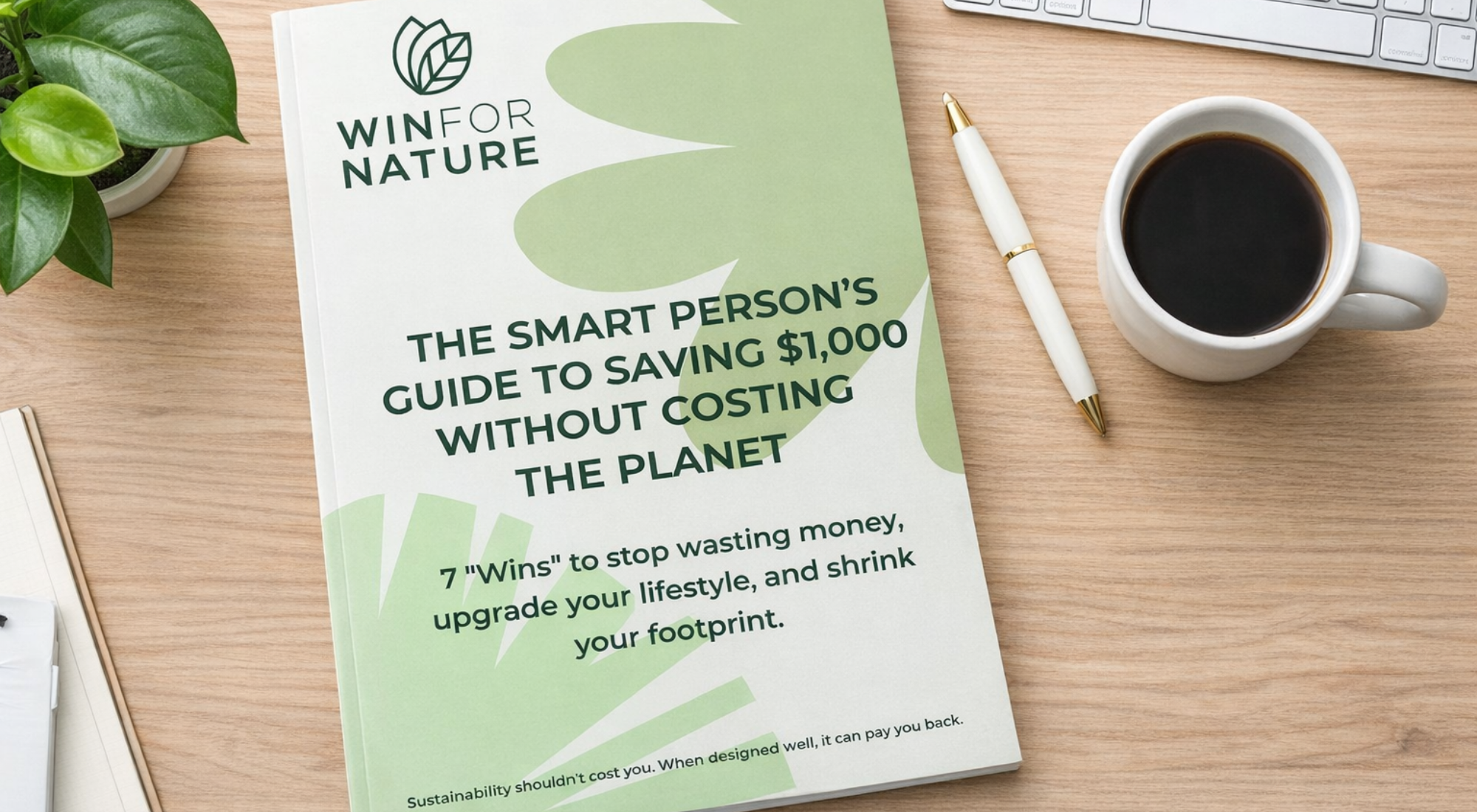
This short, practical guide explains how everyday spending can be redesigned to reduce waste, improve efficiency, and reclaim up to $1,000 a year – without costing the planet.
No slogans. No guilt. Just systems.
Check your inbox – the guide is on its way.
Check your Promotions or Spam folders if it hasn't landed in the next minute or two and add us to your safe list so we can keep the good news coming.
Unsubscribe anytime.
The hidden cost of ‘set and forget’
There's a quiet premium built into convenience. Default energy contracts. Disposable products. Subscriptions that drift upward over time.
Individually, they feel small. Collectively, they compound.
That cost shows up in two places:
- Your household budget
- Australia’s biodiversity
The issue isn’t intention.
It’s design.
This guide explores how to correct those design flaws – without increasing what you spend.
Inside the guide
This is not a list of eco-tips.
It’s a framework for thinking differently about everyday spending.
You’ll learn:
- Where the average household leaks more than $1,000 each year
- Why incentive design outperforms intention in driving behaviour
- How subscription pricing can unlock wholesale access in certain markets
- Why durability often beats discounting over a decade
- Where small consumption shifts create disproportionate environmental impact
- The structural logic behind scalable environmental funding
These are practical, implementable insights – not abstract theory.
This guide is designed for people who prefer systems over slogans.
It may resonate if:
- You’re sceptical of performative environmentalism
- You believe structure matters more than sentiment
- You care about financial efficiency as much as impact
- You want environmental progress to scale, not stall
It’s not about being perfect. It’s about being deliberate.
Built by Win for Nature
Win for Nature has built a subscription model designed to restore Australian land at scale.
Instead of relying on irregular donations, the model uses structured participation, aligned incentives, and partnerships to create predictable funding for restoration.
This guide explains the thinking behind that approach.
You can apply every idea immediately – with or without membership.
If the model makes sense to you, membership is the natural next step.
The Smart Person’s Guide to Saving $1,000 Without Costing the Planet
If you’re curious about how incentive design can reshape both personal spending and environmental funding, this will be useful.